A Practical Guide to Cytokine Selection and Reconstitution
Nov 26,2026
Cytokines are small proteins with important biological activities. They mediate intercellular communication and play essential roles in cell growth and proliferation, differentiation, and immune responses. They are widely used in cell culture and life science research.
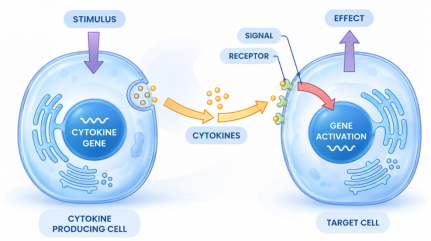
Figure 1. Schematic illustration of cytokine signaling
Using cytokines involves more than simply dissolving and adding them to a culture system. Do cytokines from different species show cross-reactivity? How do expression systems affect protein quality? Which solvent should be used to reconstitute a lyophilized cytokine, and how can protein activity loss be minimized during the process? These details can all affect cytokine performance.
In this edition of Cell Culture Academy, we explore key considerations for cytokine selection, including species cross-reactivity, expression systems, and quality assessment. We also share practical tips for reconstituting and storing lyophilized cytokines to help you use these proteins more effectively and consistently.
1. How to Select Cytokines
1.1 Identify the Target Species: Check for Cross-Reactivity
Cytokine activity can vary considerably across species. When selecting a cytokine, do not focus on its name alone. Confirm that it is active on cells from your target species.
In general:
● Most human cytokines are active on mouse cells, although there are some exceptions.
● Many mouse cytokines show some activity on human cells, but their activity is often relatively weak.
● IFNs, GM-CSF, IL-3, and IL-4 show strong species specificity. Human and mouse versions are generally not interchangeable.
● The FGF family, neurotrophins (such as BDNF, GDNF, CNTF, and β-NGF), and TGF-β are relatively conserved across species and tend to show stronger cross-reactivity.
When using cytokines from a different species than the target cells, check the cross-reactivity data for the specific cytokine. Do not assume compatibility based on the cytokine name alone.
1.2 Understand the Expression System: Protein Processing and Modifications Matter
Cytokines are commonly produced using recombinant expression technologies. When a target gene is introduced into a host cell, the host's protein expression and processing capabilities can affect the structure and properties of the final protein.
Common expression systems include mammalian cells, insect cells, yeast, and Escherichia coli. These systems differ in their ability to support protein folding, phosphorylation, proteolytic processing, and glycosylation.
The key characteristics of common expression systems are summarized below:
| Expression System | Key Characteristics |
| Human cells | Comprehensive protein-processing capabilities; more closely resemble native human proteins |
| CHO cells | Good capacity for eukaryotic protein processing |
| Insect cells | Provide some eukaryotic protein-processing capabilities |
| E. coli | Simple culture conditions and relatively low cost; folding and solubility may need optimization for some proteins |
The same recombinant protein may differ depending on the expression system used. In terms of protein processing and stability, the systems can be broadly ranked as follows: human cells > CHO cells > insect cells > E. coli. Mammalian expression systems also tend to have higher production costs.
1.3 Assess Product Quality: Purity and Biological Activity Are Equally Important
Cytokine function depends not only on successful protein expression but also on protein purity and biological activity.
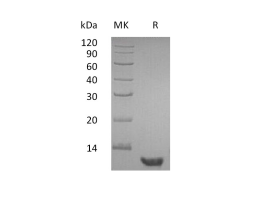
Purity and impurity control: Purity is commonly assessed by SDS-PAGE to examine the target protein and any related impurities. Endotoxins, residual host-cell components, and other impurities introduced during purification may also interfere with cell-based experiments. For cell culture applications, pay particular attention to endotoxin levels and formulation.
 |
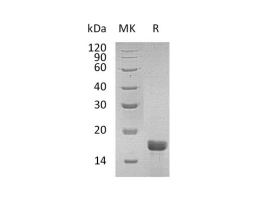 |
Figure 2. SDS-PAGE analysis of cytokine purity (left: EGF/Urogastrone/URG, Human, Recombinant; right: IL-2/TCGF/Aldesleukin, Mouse, Recombinant)
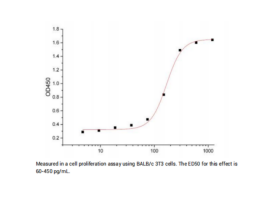
Biological activity assessment: High purity does not necessarily mean high biological activity. Because cytokines have different mechanisms of action, their activity should be evaluated using assays relevant to their specific biological functions. For example, IL-2 activity can be assessed by measuring lymphocyte proliferation, TNF activity by target-cell killing, CSF activity by hematopoietic colony formation, and IFN activity by antiviral assays. Common methods include cell proliferation assays, target-cell killing assays, and analyses of cytokine-induced products.
 |
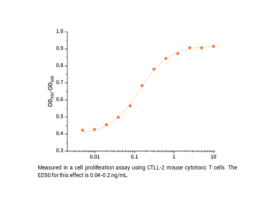 |
Figure 3. Assessment of cytokine biological activity (left: EGF/Urogastrone/URG, Human, Recombinant; right: IL-2/TCGF/Aldesleukin, Mouse, Recombinant)
Cytokine quality should therefore be evaluated comprehensively, taking into account the expression system, purity, impurity control, and results from relevant biological activity assays.
2. How to Reconstitute Cytokines
Selecting the right product is only the first step. For lyophilized cytokines, the reconstitution procedure can also affect protein stability and the reproducibility of downstream experiments.
2.1 Before Reconstitution: Check the Formulation and Product Instructions
When you receive a product, first confirm whether it is supplied as a lyophilized powder or a liquid formulation.
● Lyophilized products: Reconstitute before use according to the product instructions.
● Liquid products: These are already in solution and do not need to be reconstituted. Dilute them further as needed for your experiment.
For lyophilized products, review the reconstitution protocol and formulation information in the product instructions. Pay particular attention to the recommended solvent, reconstitution concentration, and any special handling requirements.
2.2 Choose the Right Solvent: Not Every Cytokine Can Be Reconstituted in Water
Choosing the right solvent is one of the most common challenges in cytokine reconstitution. Although many users routinely dissolve lyophilized powders in PBS, culture medium, or sterile water, cytokines differ in their physicochemical properties.
Most cytokines can be dissolved in deionized water or PBS. However, some are sensitive to pH and ionic strength and may not dissolve completely or may even precipitate under neutral or alkaline conditions.
For example, Procell's PDGF-BB/PDGF2 (C-6His), Mouse, Recombinant (PCK068) must be reconstituted under acidic conditions. The product is supplied with 10 mM HCl as the reconstitution solvent.
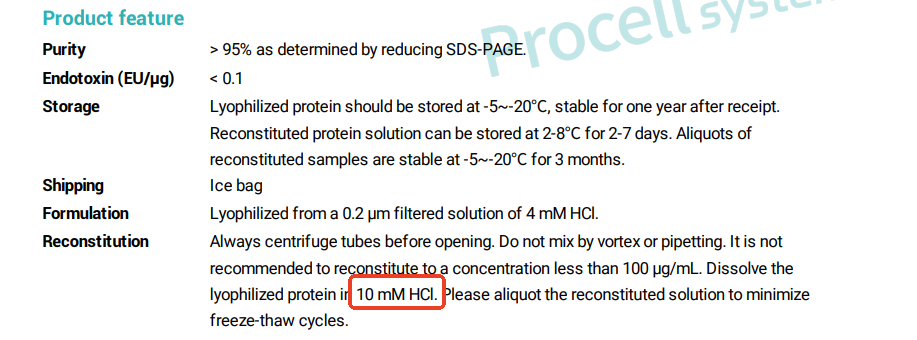
Figure 4. Formulation and reconstitution instructions for PDGF-BB/PDGF2 (C-6His), Mouse, Recombinant (PCK068)
2.3 Set the Reconstitution Concentration: Prepare a Concentrated Stock Solution First
For lyophilized cytokines, it is recommended to first prepare a relatively concentrated stock solution and then dilute it further according to the needs of the experiment.
For products supplied with sterile water and trehalose-containing PBS, the following workflow is recommended:
● Brief centrifugation: Briefly centrifuge the vial for 20–30 seconds to collect as much of the protein as possible from the vial walls or cap at the bottom of the tube.
● Initial reconstitution: Use a small volume of sterile water to dissolve the lyophilized powder. Calculate the resulting protein concentration; a concentration of at least 100 μg/mL is recommended.
● Further dilution: Use the supplied trehalose-containing PBS to dilute the protein to the concentration required for your experiment or suitable for storage.
● Aliquoting and storage: Aliquot the solution according to the product instructions and store at below −20°C.
2.4 Mix Gently: Avoid Vigorous Agitation
Proteins have specific three-dimensional structures. Vigorous mechanical agitation may increase the risk of protein aggregation or loss of activity.
During reconstitution:
● Pipette gently to ensure thorough mixing of the protein and solution.
● Avoid vigorous mixing with a vortex mixer.
● If a product dissolves slowly, follow the dissolution method specified in the product instructions or allow additional time for it to dissolve.
● Do not change the temperature or solvent conditions arbitrarily to speed up dissolution.
3. How to Store Reconstituted Cytokines to Minimize Activity Loss
Cytokines are generally much less stable in solution than in lyophilized form and are more sensitive to temperature changes and repeated freeze-thaw cycles.
3.1 Aliquot for Storage
Prepare aliquots based on your anticipated usage to avoid repeatedly thawing the entire vial. Repeated freeze-thaw cycles may compromise protein stability and reduce biological activity.
3.2 Maintain Low-Temperature Storage
Cytokines should not be left at room temperature for extended periods. For temperature-sensitive cytokines in particular, maintain the recommended low-temperature storage conditions.
3.3 Consider the Composition of the Diluent
Some proteins are prone to adsorption to tube surfaces and aggregation at low concentrations. When further diluting a cytokine, consider how carrier components may affect protein stability and surface adsorption. Whether carrier proteins such as BSA are needed depends on the product formulation, experimental system, and product instructions. Do not add them arbitrarily.
Cytokine performance depends on both product selection and proper handling. Species cross-reactivity, expression systems, purity, and biological activity all deserve attention. Proper reconstitution, aliquoting, and low-temperature storage can help minimize activity loss and support reproducible results. Understanding product characteristics and following the recommended procedures will help cytokines perform reliably in cell culture and life science research.
Prev: Bridging the In Vitro–In Vivo Gap: 3D Tumor Spheroids for Anticancer Drug Screening