How to Choose the Right Fetal Bovine Serum (FBS) for Reliable and Reproducible Cell Culture Performance
Jun 11,2026
Fetal bovine serum (FBS) is one of the most widely used natural supplements in cell culture. When combined with basal media, it is typically added at a final concentration of 10-20%, and it serves as a critical source of nutrients, hormones, growth factors, and other bioactive molecules required for cell growth and maintenance.
Experienced cell culture researchers understand that serum is both essential and highly variable. Differences in serum source, processing, and batch consistency can significantly affect cell viability, morphology, proliferation, and experimental reproducibility. Inadequate serum selection or insufficient validation may lead to unstable cell growth, contamination, poor experimental results, or even irreversible cell loss, resulting in repeated experiments and increased research costs.
Table of Contents
1. Why serum quality matters in cell culture?
2. Best practices for FBS storage and handling
3. Frequently asked questions about serum use
4. Procell Fetal Bovine Serum for research applications
5. Key takeaways for serum selection and validation
01 Why serum quality matters in cell culture?
The serum products available on the market vary greatly in quality. Without careful selection, researchers may unknowingly use suboptimal serum that negatively affects experimental outcomes.
Based on the timing of blood collection, bovine serum is generally classified into: Fetal Bovine Serum (FBS), Newborn Calf Serum (NCS), and Calf Serum (CS).
In terms of overall quality and suitability for cell culture: FBS > NCS > CS.
FBS is recommended for most mammalian cell culture applications. Certain robust cell types may adapt to newborn calf serum, whereas calf serum is generally not recommended for routine cell culture.
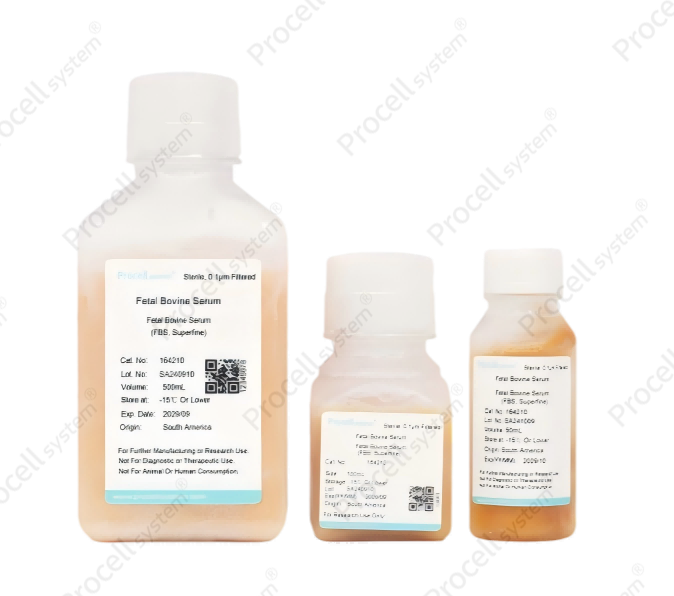
Fig. 1 Procell serum product.
02 Best practices for FBS storage and handling
2.1 Storage and thawing
FBS should generally be stored frozen at temperatures below -20°C.
Before use, serum should be thawed slowly overnight at 2-8°C. Direct thawing at room temperature or in a 37°C water bath is not recommended, as rapid warming may cause excessive protein precipitation and compromise serum quality.
If only small volumes are required for routine use, aliquoting after thawing is recommended to minimize repeated freeze-thaw cycles.
Once thawed, serum should typically be stored at 2-8°C and used within one month.
2.2 Heat inactivation
Heat inactivation is generally unnecessary for most cell culture applications.
Although the process is intended to inactivate complement proteins, studies and practical experience have shown that heat inactivation can lead to substantial protein precipitation and partial loss of important nutritional and growth-promoting components, potentially impairing cell growth and experimental reproducibility.
2.3 Serum precipitation
Precipitates observed in serum are typically composed of fibrin or other protein aggregates. Newborn calf serum, which contains relatively high protein concentrations, is particularly prone to precipitation during thawing.
In most cases, serum precipitates do not affect overall serum quality. Some precipitates may dissolve after warming to 37°C, although intentional heating of serum is generally discouraged.
If excessive precipitation occurs, the serum may be centrifuged at 400 × g for 3 minutes, and the supernatant collected for use.
Neither serum nor serum-containing culture media generally require filtration before use.
03 Frequently asked questions about serum use
3.1 How to transition cells to a new serum lot or brand
Before switching to a different serum brand or lot number, researchers should perform validation experiments using routinely cultured cell lines to confirm compatibility and growth performance.
A gradual transition is recommended. The new serum can initially be mixed with the original serum at a 1:1 ratio for 1-2 passages before complete replacement, allowing cells to adapt progressively.
3.2 What does serum color indicate?
Serum color typically ranges from light yellow to slightly reddish and is generally considered normal.
Color variation is mainly associated with hemoglobin content. Serum with unusually dark coloration (approaching the color of the culture medium) may indicate hemolysis during blood collection.
3.3 How to distinguish serum precipitates from contamination
Serum precipitates mainly result from fibrin aggregation. Some precipitation is expected after freeze-thaw cycles and usually does not affect serum performance.
Precipitates may also form after serum is added to the culture medium, especially when heat-inactivated serum is used. In some cases, these dark particles may be mistakenly interpreted as microbial contamination.
Under microscopic observation, serum-derived precipitates typically appear as irregular flocculent or particulate materials. When contamination is suspected, agar plate testing remains one of the most reliable methods for confirmation.
04 Procell Fetal Bovine Serum for research applications
Procell Fetal Bovine Serum is a premium-grade FBS sourced from South America, offering an extremely low risk of BSE and certified free of detectable viral contamination. The production process complies with cGMP standards and undergoes rigorous quality control testing, including viral testing, mycoplasma detection, endotoxin testing, and performance validation.
Key Features of Procell FBS:
1) Low endotoxin levels and free from contamination by bacteria, mycoplasma, bacteriophages, and viruses
2) No exogenous additives, including hormones or antibiotics
3) Validated using more than 300 cell lines and nearly 100 primary cell types from the Procell Cell Bank
Table 1. Procell Serum product list
| Product Name | Cat. No. | Size |
| Fetal Bovine Serum, Premium | 164210 |
|
| Fetal Bovine Serum, Standard | 164230 | 100 mL/500 mL |
| Donor Equine Serum | 164215 | 100 mL/500 mL |
| Exosome-Depleted Fetal Bovine Serum | 164222 | 100 mL/500 mL |
| Carbon Adsorption Fetal Bovine Serum | 164216 | 100 mL/500 mL |
| Dialyzed Fetal Bovine Serum | 164217 | 100 mL/500 mL |
| Lipid-Depleted Fetal Bovine Serum | 164221 | 100 mL/500 mL |
| Goat Serum | 164212 | 100 mL/500 mL |
| Chicken Serum | 164211 | 100 mL/500 mL |
| Porcine Serum | 164213 | 100 mL/500 mL |
| Fetal Bovine Serum for Mesenchymal Stem Cells | 164224 | 500 mL |
| Fetal Bovine Serum for Hybridoma Cells | 164219 | 100 mL/500 mL |
| Heat Inactivated Fetal Bovine Serum | 164223 | 100 mL/500 mL |
| Low IgG Fetal Bovine Serum | 164214 | 100 mL/500 mL |
05 Key takeaways for serum selection and validation
No single serum can satisfy the growth requirements of every cell type.
Whenever switching serum brands or even changing lot numbers within the same brand, proper validation should always be performed. In practice, minimizing batch-to-batch variability is often more important than selecting based solely on brand reputation or price.
The best serum is not necessarily the most expensive one, but the one that best supports the specific needs of your cells.
Prev: Practical Strategies for NK Cell Culture and Cryopreservation
Next: Adherent Cell Dissociation: Selection and Optimization of Reagents and Digestion Endpoints